


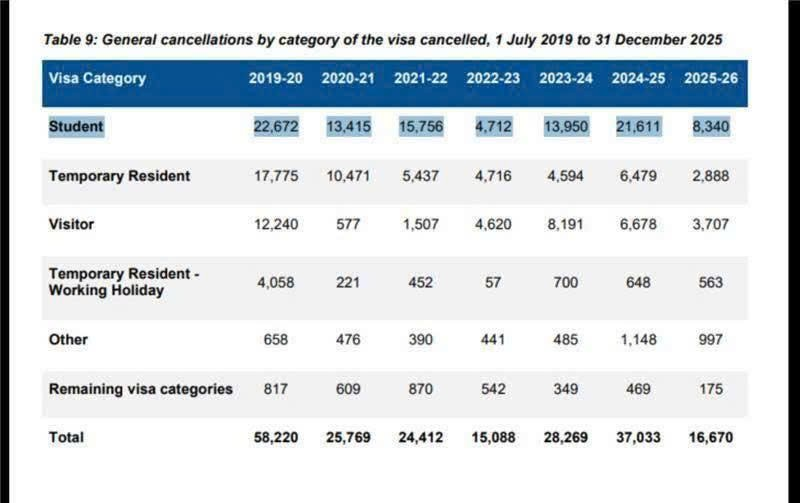
The period from 2023 to 2026 marks a significant shift in Australia’s visa management policy. As the country reopened after the pandemic, it simultaneously tightened control over individuals already residing within its borders. Data shows a sharp increase in visa cancellations during 2024–25, followed by a decline in 2025–26, reflecting a more proactive and strategic approach to migration management rather than a reactive one.
Post-COVID Phase: From Recovery to Tightened Control
In the 2023–24 financial year, more than 28,000 visas were cancelled. This number surged to over 37,000 in 2024–25, marking the highest level since the pandemic. This trend indicates that the Australian government has significantly intensified its monitoring and enforcement efforts against individuals who no longer meet visa conditions.
This increase is not coincidental but reflects a systemic policy shift. While previous strategies focused on controlling entry through application assessments, Australia is now managing the entire visa lifecycle from issuance to exit from the system.
Student Visas: The Core Focus of Enforcement
Among all visa categories, student visas have been the most affected. The number of cancelled student visas rose sharply from nearly 14,000 to over 21,000 within just one year, accounting for more than half of all cancellations in 2024–25.
This surge reflects growing concerns about the integrity of international student cohorts. Issues such as failure to maintain enrolment, working beyond permitted hours, or using student visas as a pathway for indirect migration have placed this group under increased scrutiny.
Rather than focusing solely on attracting international students, current policies aim to ensure that visa holders genuinely meet study requirements and comply with all conditions.
Other Visa Categories: Monitored but Not Primary Targets
Tourist and temporary visas continue to be monitored, although they have not experienced the same level of fluctuation as student visas. Tourist visa cancellations have shown a gradual decline after peaking in 2023–24, while temporary visas saw a modest increase before stabilising.
This indicates that current policies are not uniformly applied across all visa types but are instead targeted toward categories considered higher risk from a compliance perspective.
2024–2025: Peak of Visa Enforcement Strategy
With more than 37,000 visa cancellations, the 2024–25 period represents the peak of enforcement activity. During this time, multiple policy measures were introduced, including stricter eligibility criteria and enhanced post-grant compliance checks.
External pressures such as housing shortages, labour market constraints, and infrastructure capacity also contributed to the government’s decision to take a more aggressive stance on migration control.
2025–2026: A Technical Decline
Data for 2025–26 shows a significant drop in visa cancellations to just over 16,000. However, this is likely due to incomplete reporting for the financial year rather than a genuine policy relaxation.
The composition of cancellations still indicates that student visas remain the dominant category, reinforcing the view that strict controls are ongoing.
Long-Term Trend: Quality Over Quantity
Overall, the 2023–2026 period demonstrates a clear shift in Australia’s migration strategy. The focus is no longer on how many visas are issued, but on who remains in the system and whether they comply with the conditions attached to their visa.
This means that holding a valid visa no longer guarantees long-term stay. Visa holders must continuously meet all conditions or risk cancellation at any time.
The rising trend of visa cancellations reflects a more selective and controlled migration system. Student visas are at the centre of enforcement, while other visa categories remain under supervision but with less intensity.
For individuals planning to study or work in Australia, this environment demands greater transparency, compliance, and clarity of purpose. This is not a short-term shift but a long-term direction likely to shape Australia’s visa policies in the coming years.
How to Avoid Student Visa Cancellation in Australia
In an increasingly strict regulatory environment, holding a valid visa does not guarantee your right to remain in Australia until its expiry date. Many visas are cancelled before expiry due to non-compliance with conditions.
This requires students to proactively monitor their visa status and ensure full compliance throughout their stay.
a. Do Not Rely Solely on Visa Expiry Date
A common misconception is that a valid visa remains secure until its expiry. In reality, authorities can cancel a visa at any time if conditions are no longer met. Regular checks via ImmiAccount or VEVO are essential.
b. CoE and Enrolment Status Are Critical
The Confirmation of Enrolment (CoE) is not just an entry requirement but the legal foundation of a student visa. If a CoE is cancelled, the visa may also be at risk.
c. Attendance and Academic Progress Matter
Attending classes and meeting academic requirements are no longer formalities. Institutions report student performance, and non-compliance may lead to monitoring or cancellation.
d. Working Conditions Must Be Respected
Breaching work-hour limits or failing to comply with employment conditions can result in serious consequences, including visa cancellation.
e. Always Monitor Official Communications
Important notifications from schools or the Department of Home Affairs may require timely responses. Ignoring them can escalate minor issues into serious risks.
f. Follow Proper Procedures for Deferral
Deferring studies must be formally approved. Unauthorised breaks can lead to visa breaches.
g. Prepare Documents When Re-entering Australia
Border authorities may request proof of enrolment and visa status. Ensure all documents are up to date.
h. Be Cautious When Leaving Australia
Leaving Australia during a “sensitive” visa status (e.g. cancelled CoE or bridging visa) may affect your ability to return. Seek professional advice before travelling.
Compliance Is No Longer Optional
Australia’s visa system is evolving into a stricter and more controlled framework. Compliance is no longer an advantage it is a requirement. Understanding and following visa conditions is essential to maintaining your legal status in Australia.


