

A new technology developed in Canberra, Australia, is opening up the potential to significantly reduce global milk waste, which currently exceeds 150 million tonnes each year. This solution enables dairy producers to assess raw milk quality within minutes, instead of waiting several days as required by traditional testing methods.
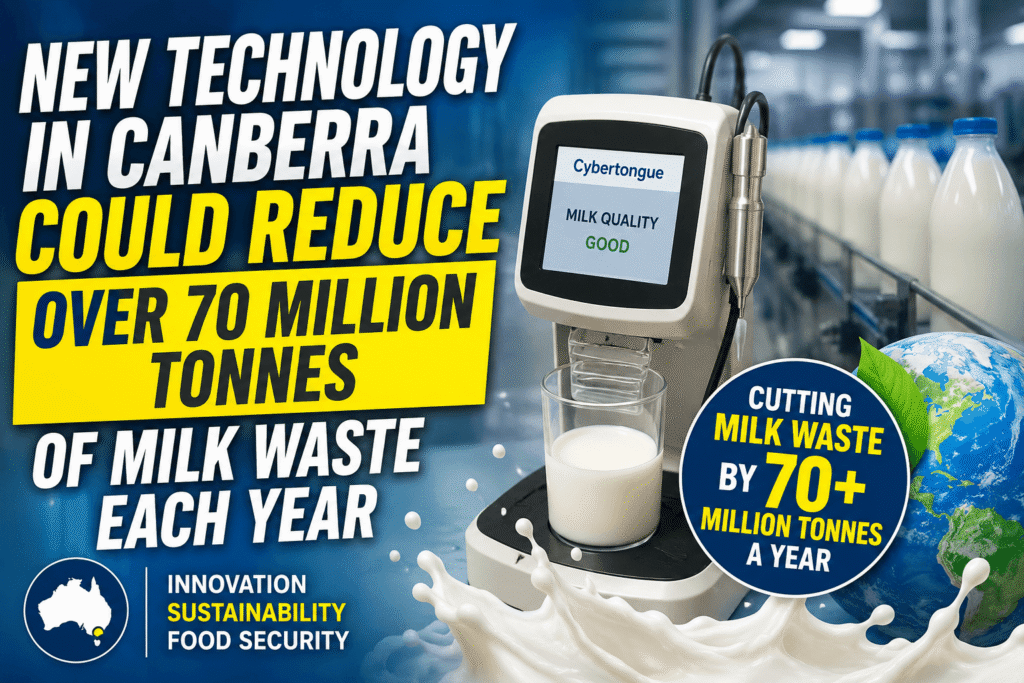
The technology, known as Cybertongue, was developed by PPB Technology and uses advanced biosensors to detect factors that may impact milk quality. This allows manufacturers to quickly determine the appropriate processing level and avoid unnecessary waste.
Reducing Testing Time from Days to Minutes
Previously, dairy companies had to send samples to laboratories and wait two to three days for results. With Cybertongue, the entire process can now be completed on-site in approximately three minutes.
Stephen Trowell, founder of PPB Technology, explained that the system measures how sensitive raw milk is to protease enzymes—one of the key factors that can reduce product quality and shelf life.
“Some dairy products, especially UHT milk, are more sensitive to these enzymes. With better control, we can extend shelf life and significantly reduce losses,” he said.
Reducing Waste Through Smarter Classification
By accurately identifying enzyme levels, producers can better classify raw milk. Lower-quality batches can still be used for products like cheese or yogurt, rather than being completely discarded.
The technology also helps identify issues across the supply chain, from farms to processing plants, allowing for more efficient production and reduced losses.
It is estimated that if widely adopted, Cybertongue could reduce between one-third and one-half of global milk waste—equivalent to more than 70 million tonnes annually.
From Explosives Detection to Food Innovation
The foundation of Cybertongue originated from research conducted at CSIRO, Australia’s national science agency. Initially, the technology was designed to detect explosive vapors and assess wine quality.
After more than 30 years of development, Trowell recognized its broader potential in the food industry and established a company to commercialize the innovation.
“We realized this technology could be applied across multiple industries, including food, environmental monitoring, and healthcare,” he noted.
Global Impact on Food Security
According to the Food and Agriculture Organization (FAO), global milk production reached approximately 979 million tonnes in 2024. However, around one-sixth of this supply is lost or wasted.
UHT milk accounts for a large share of global consumption, particularly in developing countries where cold storage systems are limited. Improving shelf life in these regions is critical for both nutrition and food security.
This new technology not only helps Australian producers reduce export risks but also enables other countries to extend product shelf life from a few months to up to six months.
Future Applications in Food Safety
Cybertongue is already being used in regions including North America, Europe, Africa, and Asia. In the future, it could be expanded to detect allergens and bacterial toxins in food.
Trowell believes this innovation could represent a major breakthrough not only for the dairy industry but also for global food safety, potentially evolving into a multi-billion-dollar technology platform.
Source: ABC News