


Many people think that when encountering a problem abroad, just call the Australian Embassy and the Australian government will solve the problem. Reality is not quite like that. Australian missions abroad can assist citizens in many serious situations, but their powers are limited and cannot replace the police, hospitals, lawyers, insurance companies or authorities of the host country.
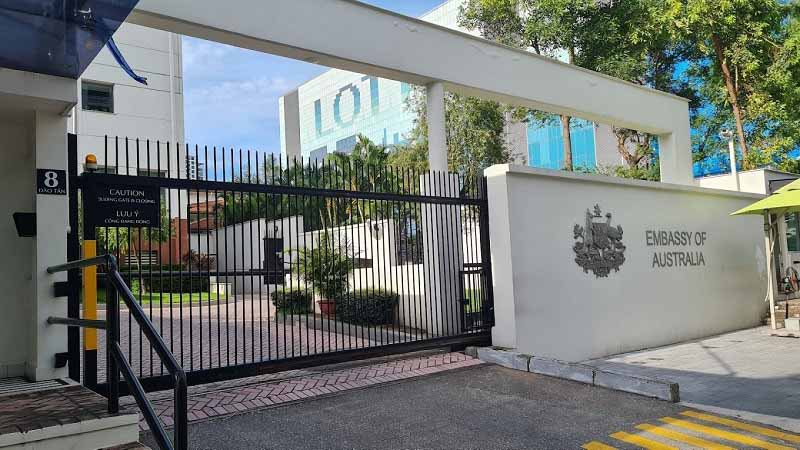
If you are an Australian citizen overseas and are involved in an accident, lose your passport, are arrested, become a victim of crime or find yourself in an emergency situation, understanding what the Embassy can do will help you deal with the matter more quickly.
When should you contact the Australian Embassy?
If you are in an immediate life-threatening situation, the first thing to do is still call the police, ambulance or the emergency number in your country. Once you have arrived safely or have contacted local emergency authorities, you can contact your nearest Australian Embassy, High Commission or Consulate General for guidance and consular assistance.
In the event of an out-of-hours emergency and requiring urgent assistance, Australian citizens can contact the Australian Government’s 24-hour Emergency Consular Assistance Center. If calling from abroad, the phone number is +61 2 6261 3305. If you are in Australia, you can call 1300 555 135.
In Vietnam, Australian citizens can contact the Australian Embassy in Hanoi at +84 24 3774 0100. In the event of an after-hours emergency, calls may be routed to the Emergency Consular Support Center in Canberra.
Lost or stolen passport: The Embassy can issue replacement documents
Losing a passport overseas is one of the most common situations in which Australian citizens require consular assistance. The Australian embassy or representative agency can assist you in applying for a replacement passport or travel documents if eligible. You still must verify your identity and pay the prescribed fees.
In case of urgent travel, Australian citizens may be considered for an emergency passport. This type of passport is usually valid for a maximum of one year and does not have an electronic chip, so some countries may apply different regulations when entering or transiting. It is important that after losing your passport, you should report it to the local police if possible and notify the Australian Government so that the lost passport can be destroyed to avoid being used by others.
However, there is one point that many people easily misunderstand: Re-issuing Australian documents does not mean that the visa of the country you are in will automatically be restored. You may have to contact your home country’s immigration authority to transfer or reissue your visa on your new passport.
Have an accident or serious illness: The Embassy supports connection, does not pay hospital fees
If you have an accident or serious illness abroad, the consulate can provide information about appropriate local hospitals, doctors and medical services.
In serious cases, with your consent, consular officers can also assist in contacting family or relatives to inform them of the situation.
But the Embassy isnot a hospital and not an insurance company. The consulate cannot diagnose the disease, decide on treatment, request a hospital to admit the patient, or pay hospital bills, medication costs, and medical transportation costs on your behalf. This is why travel insurance is especially important when Australian citizens go abroad. The cost of treatment, hospitalization or international medical transportation can reach thousands, even tens of thousands of dollars.
Becoming a victim of assault or sexual abuse
If you are assaulted, robbed or sexually assaulted abroad, your first priority should still be to leave the dangerous place and seek medical attention if needed. The consulate can then help you find medical facilities, explain local support options, and give instructions on how to reach the police or victim services.
In appropriate cases, consular officers can also provide a list of lawyers, assist with contacting family or friends, and help you connect with local support services. If you are in serious financial difficulties and have no other options, in some special cases the Australian Government may consider an emergency loan. This isnot a free grant and is usually required to be repaid by the recipient.
Importantly, the Embassy cannot represent you in court, provide legal advice on behalf of a lawyer or force local police to investigate and prosecute the matter.
Arrested or detained abroad: What can the Embassy do?
If arrested or detained by foreign police, Australian citizens should request to contact an Australian representative agency. Consular officers may visit or contact you to check your health status and detention conditions, provide information about lawyers, assist with family communication if agreed, and monitor cases within the scope of consular functions. In some cases, they may also raise serious issues related to health or treatment conditions to the appropriate authorities.
But there is a very important principle: an Australian passport does not exempt you from the laws of the host country. If you are arrested in Vietnam, Thailand, Japan, the United States or any other country, you still must comply with the laws of that country. The Embassy cannot release you from jail, pay your bail, fines or attorney fees, investigate the case, interfere with the judicial process, or declare your innocence. Simply put, the Embassy can provide consular assistance, but cannot act as your lawyer or judicial authority.
Out of money or unable to buy a ticket back to Australia
If you lose money, your bank card doesn’t work or you can no longer buy a plane ticket back to Australia, don’t assume that the Embassy will buy a ticket for you. Typically, the consulate will help you find ways to contact family, friends, banks or insurance companies to find financial resources. In exceptional circumstances and after other options have been exhausted, the Australian Government may consider providing support in the form of an emergency loan. However, this has conditions and the money received must be returned.
Therefore, when traveling abroad, having backup funds and appropriate insurance is still your own responsibility.
Relatives missing or deceased overseas
If a relative who is an Australian citizen is missing overseas, the family can contact local police, police in Australia and the Emergency Consular Assistance Center. Consular offices can coordinate with families and local authorities, support information exchange and guide families on necessary procedures.
If an Australian citizen dies overseas, consulates can help the family understand local processes, provide information about relevant services and assist with communication with authorities. However, the cost of burial, cremation or bringing the body back to Australia is usually not paid by the Australian Government. This is where travel insurance can play a very important role.
Natural disasters, conflicts or major crises
In the event of a serious natural disaster, conflict, terrorism or political instability that puts Australian citizens at risk, the Australian Government may deploy special support measures. Depending on the situation, the Government can coordinate with local authorities, provide safety information, assist citizens in finding ways to leave dangerous areas, or in some cases organize departure plans when commercial flights are no longer available. However, not every crisis leads to the Australian Government organizing the evacuation of citizens.
If there are still safe commercial vehicles, citizens should not wait until the Government organizes an evacuation to try to leave the dangerous area.
Pay special attention if you have dual citizenship
This is a very important issue for Vietnamese people with Australian citizenship. If you are both an Australian citizen and a citizen of the country you are visiting, your ability to obtain consular assistance from the Australian Government may be limited. For example, dual nationals of Australia – Vietnam while in Vietnam may face certain limitations in accessing consular assistance. Vietnam can consider that person as a Vietnamese citizen and apply Vietnamese law to them.
Using an Australian passport when entering the country also does not guarantee that you will be fully entitled to Australian consular assistance if the host country still recognizes you as its citizen. This is a point people with dual citizenship need to learn before deciding which passport to use when entering and exiting the country.
The Australian Embassy is not a “rescue line” for all problems
It can be simply understood that the role of the Australian Embassy when citizens encounter problems abroad is mainly support, guidance and connection. They can help you access information, contact family, find a hospital or lawyer, assist with travel documents, contact authorities and, in some serious situations, assist with emergency plans.
But they cannot replace the police, hospitals, lawyers or insurance companies. They also cannot stand above the laws of the country you are in. Therefore, before each trip, Australian citizens should check safety information on Smartraveller, buy appropriate travel insurance, save copies of passports and visas, save phone numbers of insurance companies and relatives, and keep the number +61 2 6261 3305 handy when emergency assistance is needed.
Understanding the Embassy’s limitations does not mean you cannot be supported. On the contrary, knowing exactly what they can do will help you call the right place at the right time and handle problems more effectively while abroad.
Source: SBS


