


From 1 July 2026, the Australian Government officially enacted a wide-ranging package of reforms across the immigration and citizenship system. These statutory adjustments directly affect international students, skilled workers, family visa applicants, and sponsoring Australian employers.
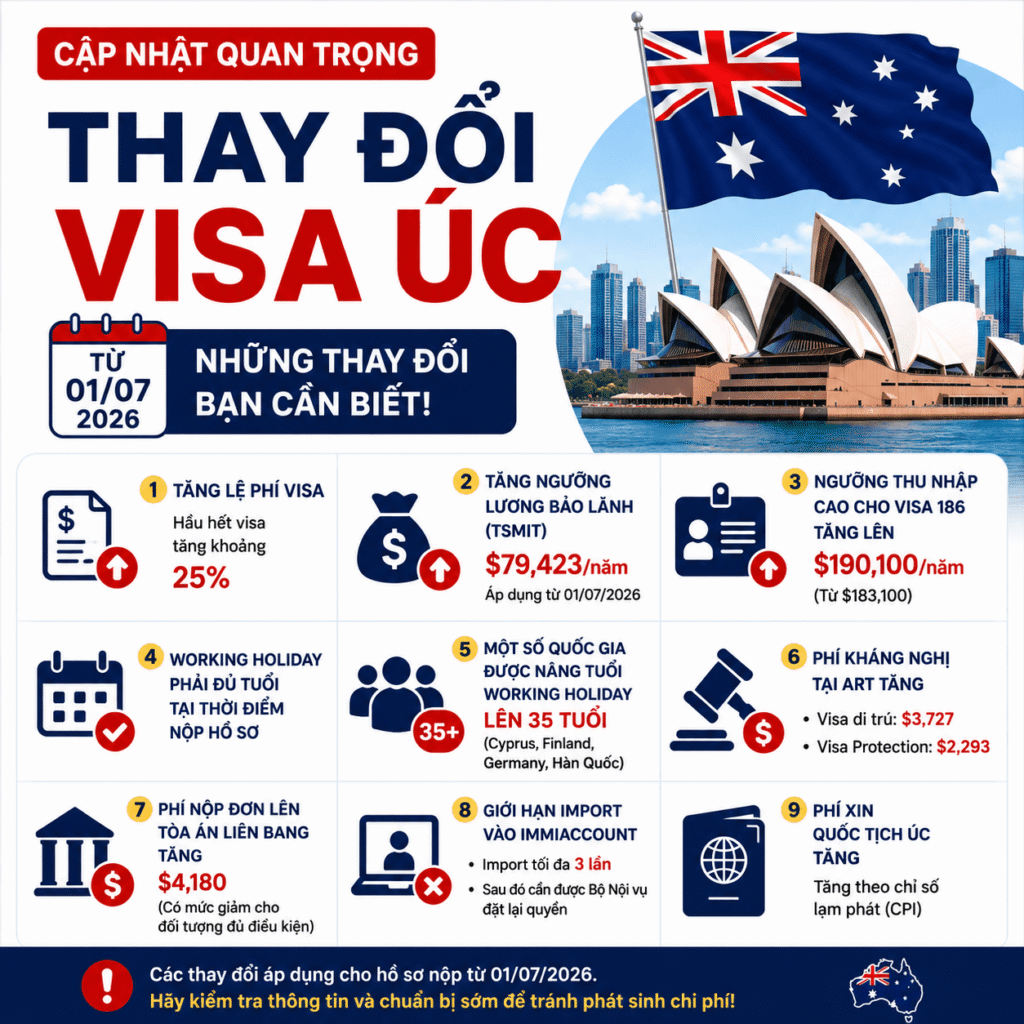
Summary of Key Changes Taking Effect
1. Visa Application Charges (VAC) Adjusted
Across most mainstream visa streams, application fees have been increased by approximately 25%, alongside standard Consumer Price Index (CPI) indexation. Certain humanitarian and Pacific mobility categories remain indexed to CPI only.
2. Australian Citizenship Application Fees Indexed
Application fees for Australian Citizenship by conferral and descent have been updated to reflect annual CPI inflation rates.
3. Skilled Migration Income Thresholds (TSMIT / CSIT) Raised
The statutory baseline for employer sponsorship under Subclass 482, Subclass 186, and Subclass 494 has risen to AUD 79,423 per annum.
4. Fair Work High Income Threshold Increased
The Fair Work High Income Threshold rose from AUD 183,100 to AUD 190,100 per annum, impacting age exemption criteria under Subclass 186.
5. Working Holiday Visa Age Assessment Rule
For Subclasses 417 and 462, applicants must now meet the statutory age requirement strictly at the time of application lodgement.
6. Age Limits Raised to 35 for Selected Partner Nations
Under new bilateral agreements, the maximum eligible age for Working Holiday makers from Cyprus, Finland, Germany, and the Republic of Korea has expanded from 30 to 35 years of age.
7. Tribunal & Court Review Fees Updated
Filing fees for migration appeals at the Administrative Review Tribunal (ART) are now AUD 3,727 (AUD 2,293 for protection matters), while Federal Circuit Court judicial review lodgement is AUD 4,180.
8. ImmiAccount Application Import Restrictions
To enhance data security and prevent unauthorized access, individual visa applications can now be imported into ImmiAccount a maximum of 3 times.
Source: VisaEnvoy Migration Analysis