


Have you ever invested countless hours studying, only to struggle when presented with unfamiliar exam questions? Rote memorization often fails when university assessments require critical application and synthesis rather than textbook repetition. This discrepancy occurs when study habits remain at a lower cognitive level than assessment expectations.

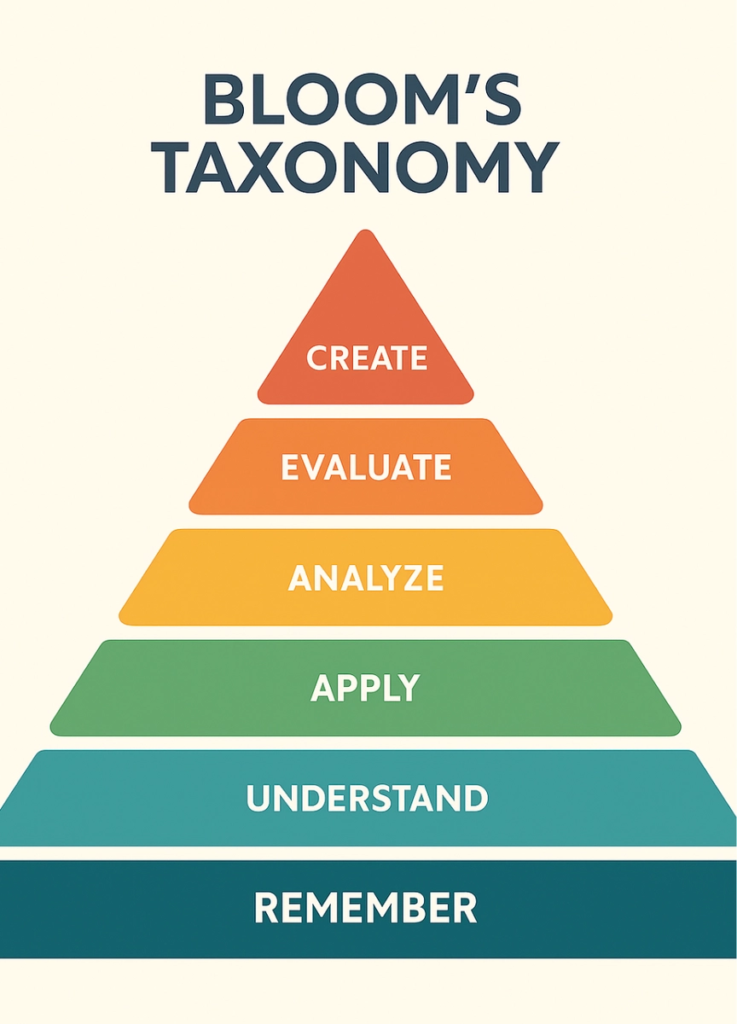
A proven framework for mastering higher education is Bloom’s Taxonomy, which organizes cognitive progression into six progressive tiers: Remember, Understand, Apply, Analyze, Evaluate, and Create.
Level 1: Remembering fundamental knowledge
Remembering involves recalling definitions, formulas, and baseline facts. While foundational, memorization alone is insufficient for higher-tier academic problem solving.
Level 2: Understanding concepts and meaning
Understanding means explaining concepts in your own words, drawing analogies, and distinguishing core ideas from related topics without reciting rote definitions.
Level 3: Applying knowledge to practical scenarios
Applying knowledge requires selecting and executing appropriate methodologies to resolve concrete business case studies, engineering problems, or mathematical challenges.
Level 4: Analyzing components and relationships
Analysis deconstructs complex problems into constituent parts, examining causal relationships, systemic dependencies, and comparative differentiators.
Level 5: Evaluating through critical thinking
Evaluation involves forming reasoned judgments, critiquing competing viewpoints, and defending academic conclusions using verifiable empirical evidence.
Level 6: Creating original synthesis and solutions
The pinnacle of Bloom’s Taxonomy, Creation integrates disparate theories to construct innovative proposals, research models, or functional frameworks.
Academic success strategy for Australian universities
Australian universities assess students predominantly at Analysis, Evaluation, and Creation levels. Structuring your revision around these higher-order cognitive tiers ensures superior academic performance across essays, research dissertations, and examinations.
Source: Vivian / Educational Psychology Review / De1 Academic Insights